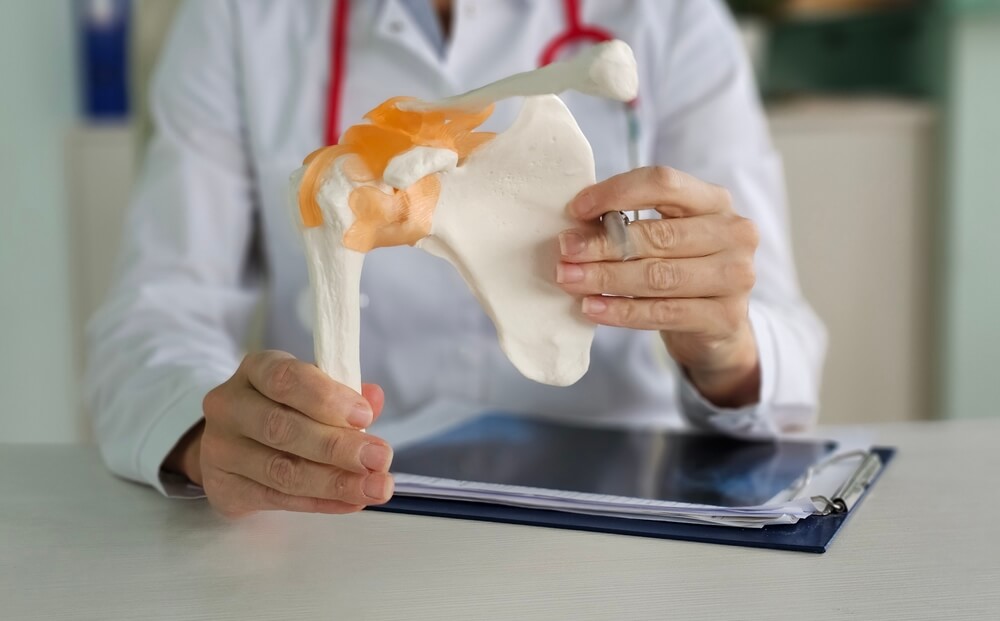
What is a Total Hip Replacement (THR)?

Who is an ideal candidate for this treatment?

  • Chronic hip pain and significant mobility limitation affect simple daily activities.
  • Imaging has confirmed joint damage involving both the ball and socket of the hip joint.
  • Typically, older patients suffer from severe arthritis (osteoarthritis, rheumatoid arthritis), rather than because of a single event.
  • Conservative treatments have failed to treat pain and mobility.

Hip pain changes how you live. Understanding your options is the first step to recovery. Are you ready to walk pain-free? Book Now

Do I need help? Possible Signs

  • A dull, deep, chronic, and persistent pain in the groin or buttock that has gradually worsened over time due to arthritis.
  • Difficulty or pain walking, standing, and even at rest (pain can be worse when you first start moving after resting or can even interfere with sleep).
  • Significant stiffness and reduced range of motion in simple tasks (putting on socks or getting in and out of a chair).

What to expect before surgery?

  • Compassionate Care
  • Thorough Examination & Personalized Treatment Plan
  • Patient’s Goals Discussed & Straight Answers to Difficult Questions
  • Support You Can Count On

Non-Surgical options

Many patients find temporary relief through conservative measures. These non-surgical treatments are typically designed to manage symptoms, but not reverse hip joint damage. Non-surgical options include the following:

  • Targeted physical therapy to strengthen the muscles supporting the joint.
  • Modifying activity by swapping high-impact (running) for low-impact (swimming).
  • The use of assistive devices (cane/walker)
  • NSAIDs: Over-the-counter anti-inflammatory medications
  • Injections: Corticosteroids or hyaluronic acid to reduce inflammation.

Definition of Treatments:

The Total Hip Replacement (THR) is the “Gold Standard” for chronic hip issues with a higher degree of surgical complexity. The entire joint is replaced, including exchanging the Femoral head (ball) with an artificial ball and the acetabulum (socket) with an artificial socket. The surgeon removes both the acetabulum (the hip socket) and the femoral head (the “ball” at the top of the thigh bone). Both are replaced with durable medical-grade metal, ceramic, or plastic components to restore full joint mechanics.

FAQs

Mobility

A Total Hip Replacement (THR) typically provides a better long-term range of motion and function because both “mating surfaces” of the joint are perfectly engineered.

Risk of Recurrence

Lower risk of future joint-related problems because prosthetics for both the ball and socket of the hip joint are used, resulting in significantly less wear. 

Cosmetic Consideration

A total hip replacement usually requires a slightly larger incision than a partial replacement, with most incisions for total or partial replacement being 4–6 inches, with over 90% of patients saying the long-term scar appearance is good or better.

Recovery Timeline

  • In the first 24-48 hours, patients often begin walking with a walker or crutches, and physical therapy begins to improve circulation and prevent stiffness. You’ll need help with washing, dressing, and going to the bathroom.
  • In two to four weeks, most patients will transition from a walker to a cane, and walking will become easier. You should be able to get dressed and use the bathroom on your own. Stitches and staples are removed, and physical therapy becomes more targeted and challenging as patients work to maintain the hip’s range of motion and strength. Physical therapy at home may begin.
  • In four to six weeks, most patients can walk without a cane and return to normal daily living activities, including driving and a desk job. By 10-12 weeks, you should feel much more like yourself and be able to perform nearly all daily activities, including most low-impact exercises.
  • In 4-6 months, around 90% of function is restored. Ongoing physical therapy at home and the therapy center focuses on ongoing progress in function, strength, and comfort. Most achieve total healing in 6-12 months.

Considerations/Risks

Typical
  • The most common risks are infection, blood clots, dislocation, and implant wear over time.
Atypical
  • Nerve or blood vessel injury (rare) resulting in temporary numbness or weakness in the leg.
  • If the total hip replacement needs to be replaced by the patient, it may result in a more complex revision/correction later.

Why Choose Lone Star?

  • Board-Certified Orthopaedic Surgeons with Exceptional Expertise
  • Advanced Surgical Techniques and Technology
  • Reputation for Patient-Centered Care and Results
  • Collaborative Care Team Approach

Disclaimers:

  • The information provided on www.lonestar-ortho.net is intended for general informational and educational purposes only. The content on this website is presented in summary form, general in nature, and should not be considered medical advice, diagnosis, or treatment recommendations.

  • The materials and information provided on this website are not intended to replace professional medical advice, care, or consultation with a qualified healthcare provider. Always seek the advice of your physician or another qualified healthcare professional regarding any medical condition, treatment option, or health concern.

  • Do not ignore professional medical advice or delay seeking care because of something you read on this website. If you think you may have a medical emergency, call 911 or seek immediate medical attention.

Book Your Appointment Today

If arthritis is wearing down your joint, the right solution is not limiting yourself further. We offer a long-term fix to your mobility and pain, allowing you to return to the life you have been putting off for months or even years.